Flowers ›
Verbena
Verbena × hybrida
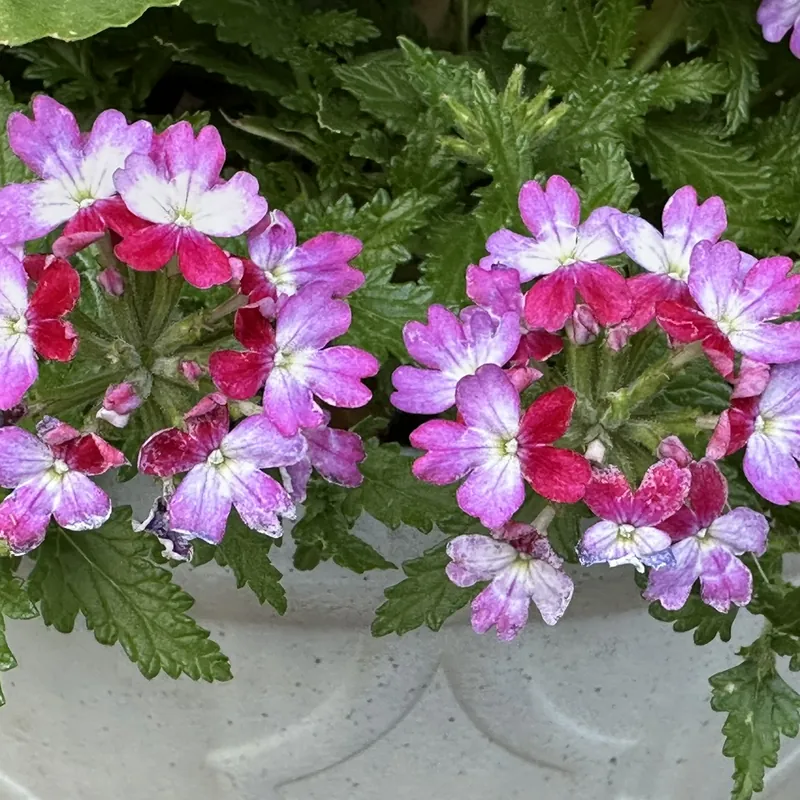
Garden verbena (Verbena × hybrida) is a group of hybrids in the verbena family, bred from species native to the Americas. Botanists now place these plants in the closely related genus Glandularia, and the RHS lists them as Glandularia × hybrida, but garden centers still sell them as verbena. Plants range from low, trailing mats about 10 inches tall to bushy, upright plants up to 20 inches, with oblong, toothed, rough leaves. From late spring to fall they carry rounded clusters, up to 3 inches across, of small five-petaled flowers in blue, violet, purple, rose, dark red, yellow, white and bicolors. Some are fragrant.
It is a short-lived perennial, hardy only in zones 9 and 10, and most gardeners grow it as an annual. It earns its place with a long season of bright color, good tolerance of heat and drought, and a steady stream of butterflies and hummingbirds. Trailing kinds are some of the best plants for hanging baskets and window boxes.
Planting
- When: set plants out after the last frost. Find your date with our frost date lookup.
- Light: full sun. Verbena tolerates light shade, but flowers best in sun, and shade invites powdery mildew.
- Soil: average to moderately fertile, well-drained soil, or a potting mix in containers. It does not like soil that stays wet, crowding or poor air circulation.
- From seed: seed strains can be started indoors 8 to 10 weeks before the last frost. Many named series are grown from cuttings and sold only as plants.
- Pinch the tips of young plants at planting to make them bushier.
Care
Water new plants regularly for the first few weeks. Once established, verbena is drought tolerant, but flowering suffers in long dry spells: Clemson suggests a thorough watering about once a week during bloom when there has been less than an inch of rain. Water at the base rather than over the leaves. A light feeding in spring and again after trimming is enough in the ground; plants in pots need feeding more often, and the RHS advises feeding and watering container plants well. See container gardening.
Deadhead spent clusters to keep flowers coming. If flowering slows in midsummer, cut the whole plant back by about a quarter, water and feed lightly, and it should flower again in 2 to 3 weeks. Clemson notes that seed-grown bedding verbenas often struggle in hot, humid summers, while vegetatively propagated types handle heat better.
Overwintering
Frost kills garden verbena outside zones 9 and 10, and the RHS rates it H3, hardy only in mild coastal areas of Britain. To keep a favorite, take cuttings in late summer and keep them indoors over winter, or bring a whole container inside. Otherwise, buy new plants or start seed each spring.
Pollinators
Missouri Botanical Garden lists garden verbena as attracting hummingbirds, butterflies and other pollinators, and Clemson's Home and Garden Information Center says all verbenas attract butterflies, bumblebees and hummingbirds. A basket by a porch or window makes an easy place to watch them. See building a butterfly garden and cardinal flowers and hummingbirds for plants to go with it.
Garden verbena and Verbena 'Bampton'
The site also has a page on Verbena 'Bampton', and the two are quite different plants. 'Bampton' is a selection of common vervain (Verbena officinalis), a short-lived perennial hardy to about zone 7. It grows 2 to 3 feet tall on wiry stems with purple-bronze leaves and loose, airy sprays of tiny lilac-pink flowers, and it self-sows. Garden verbena is a low, tender hybrid grown mostly as an annual, with broad, flat clusters of larger flowers in many colors. Use 'Bampton' as a see-through filler in a border; use garden verbena for edging, ground cover, baskets and pots. Verbena bonariensis, another popular kind, is taller still, at 4 to 5 feet.
Varieties
NC State lists many series, most sold as plants:
| Series | Habit and notes |
|---|---|
| Superbena | Mounding, becoming more spreading; many colors |
| Superbena Sparkling | Two-toned colors; trailing |
| Lanai | Trailing; good disease resistance |
| Tuscany | Upright, spreading; heat tolerant, larger flowers |
| Obsession Cascade | Trailing; from seed; disease resistant |
| Quartz XP | Mounding and spreading; long-lasting flowers |
| Aztec | Mounding; pink, red, purple and white |
Problems
Missouri Botanical Garden reports no serious insect or disease problems, but a few things go wrong when conditions are off. Powdery mildew is the most common, especially on plants in too little sun or under drought stress; some varieties resist it. Root rot and botrytis blight follow soil that stays wet or overwatering. Aphids, whiteflies, thrips and leaf miners sometimes feed on the plants, spider mites show up on drought-stressed plants, and slugs can be a nuisance in wet weather. Rutgers rates Verbena × hybrida as seldom severely damaged by deer, and NC State notes that deer usually leave it alone; see deer-resistant gardening.
Sources
- Verbena × hybrida, Missouri Botanical Garden Plant Finder, accessed 2026: zones 9 to 10, size and habit, flower clusters and colors, fragrance, bloom season, culture, seed starting, pinching, deadheading, overwintering cuttings and containers, hummingbirds and butterflies, no serious problems
- Verbena × hybrida, NC State Extension Gardener Plant Toolbox, accessed 2026: habits, drought tolerance, deer, mildew resistance, root rot, series descriptions
- Verbena × hybrida, Royal Horticultural Society, accessed 2026: Glandularia name, H3 hardiness, cultivation, container feeding, deadheading, aphids, slugs, powdery mildew
- Verbena, Clemson Cooperative Extension Home and Garden Information Center: soil and spacing, watering, fertilizing, cutting back, heat tolerance of seed-grown and vegetative types, pollinators, diseases and pests, Verbena bonariensis