Flowers ›
Blue Lobelia
Lobelia erinus
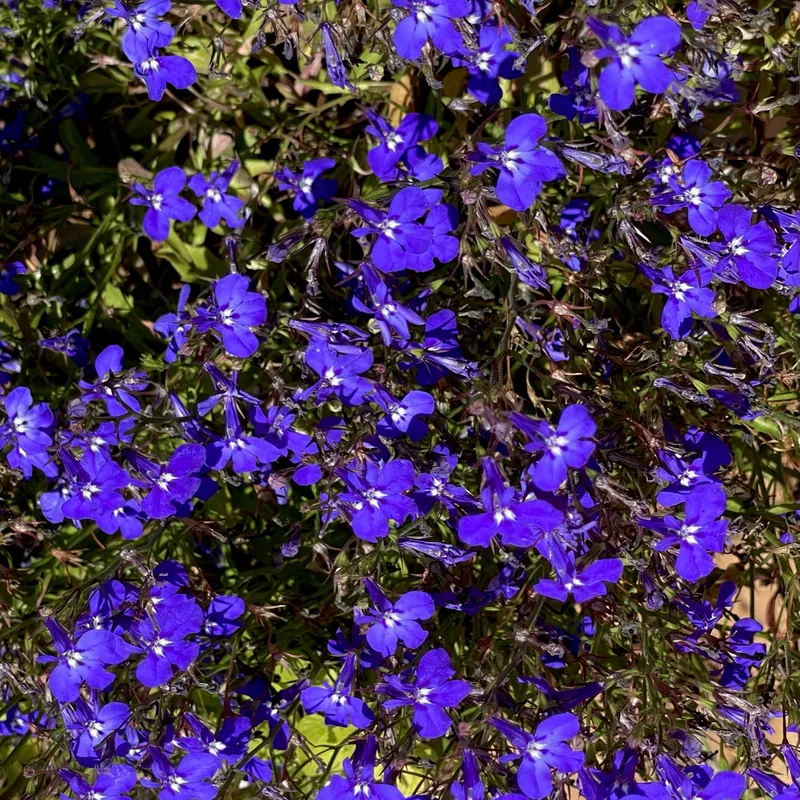
Blue lobelia, also called edging, garden or trailing lobelia (Lobelia erinus), is a small plant from southern Africa grown for sheer quantity of flowers. Each bloom is only about ½ inch across, two-lipped, with the broad, fan-shaped lower lip typical of lobelias, but a healthy plant is covered in them. Blue and violet are the classic colors, usually with a white or yellow eye, and there are also purple, red, pink and white forms. The leaves are narrow and tiny, sometimes tinged bronze.
It is a tender perennial, hardy only in zones 10 and 11, and grown as an annual everywhere else. Plants come in two shapes: upright, mounding types 4 to 9 inches tall for edging beds, and trailing types that spill over the sides of hanging baskets, window boxes and pots. It is not the same plant as great blue lobelia (Lobelia siphilitica), the tall native perennial, or its red cousin the cardinal flower.
Best in cool weather
The thing to know about edging lobelia is that it loves cool springs and dislikes hot, humid summers. Missouri Botanical Garden compares it with pansies: it blooms beautifully in spring and early summer, typically April to June, then starts to decline when summer heat arrives. In cool-summer areas it keeps blooming all season. Where summers are hot, plan on a spring show, a midsummer rest, and a second round in fall.
When plants look tired in midsummer, cut them back and keep watering and feeding them. Both Missouri Botanical Garden and NC State Extension recommend cutting back after flowering to bring on new blooms, and Missouri Botanical Garden suggests it as the way to get a fall bloom (or, it adds, simply pull the plants out). In mixed containers, you can simply snip out the worst stems and let neighboring plants fill in.
Planting
- Light: full sun to part shade. In hot-summer regions, give it morning sun and afternoon shade; Missouri Botanical Garden suggests part shade in St. Louis.
- Soil: rich, moist, well-drained soil or a good potting mix.
- Timing: set out plants after your last frost (check your dates with our zip code lookup).
- Spacing: about 6 to 10 inches apart (Proven Winners' spacing for its Laguna types).
Starting from seed is possible but slow and fussy. The tiny seeds need to be started indoors 8 to 10 weeks before the last frost, and both Missouri Botanical Garden and NC State note that most gardeners have better luck buying cell packs of young plants each spring.
Care
- Water: keep the soil evenly moist. Lobelia does not tolerate drought. Check containers daily in summer.
- Feeding: a diluted liquid fertilizer about every two weeks through the growing season.
- Problems: few insect pests. Midsummer dieback is the main complaint. In soggy soil, watch for damping-off in seedlings and stem and root rot in older plants.
Varieties
- 'Crystal Palace': dark blue flowers over bronze-green leaves on a compact, upright plant.
- 'Cambridge Blue': soft, clear blue on compact plants 4 to 6 inches tall.
- 'Rosamunde': carmine red with a white eye.
- 'White Lady' and 'Snowball': pure white.
- 'Sapphire': purple-blue with a white eye, a trailing type NC State calls one of the best.
- 'Hamburgia': a trailing form for baskets and raised planters.
- Laguna series: cutting-grown trailers, 6 to 12 inches tall and up to 2 feet wide. Proven Winners says they handle heat better than older seed types and keep blooming unless nights stay in the upper 70s, and they do not need deadheading.
Pollinators
Missouri Botanical Garden notes the flowers attract butterflies, and NC State lists it for butterfly gardens and as a pollinator plant. Neither mentions hummingbirds, and the flowers are small and low to the ground. Its real value in a pollinator planting is as a long-blooming edger in front of taller nectar plants.
Toxicity
All parts of Lobelia erinus are poisonous if eaten. NC State Extension rates it medium severity: the alkaloids lobeline and lobelamine can cause nausea, vomiting and diarrhea, and large amounts can lead to convulsions and coma. It does not irritate skin. Keep it where small children and pets won't chew on it; see poisonous garden plants and pets. Deer usually leave it alone.
Design ideas
- Shade containers: trailing lobelia spilling over the edge of a pot with an upright fuchsia in the center and begonias around it.
- Hanging baskets and window boxes: blue lobelia mixed with white or pink trailing flowers.
- Bed edges: a low blue ribbon along a path in front of sweet alyssum, petunias or marigolds.
- Rock gardens: small clumps tucked between stones in light shade.
Sources
- Lobelia erinus, Missouri Botanical Garden Plant Finder, accessed 2026: zones, size, bloom season, summer decline, seed starting, fertilizing, uses, butterflies.
- Lobelia erinus, NC State Extension Gardener Plant Toolbox, accessed 2026: native range, flower colors, cutting back, diseases, toxicity, cultivars.
- Laguna Ultraviolet lobelia, Proven Winners, accessed 2026: Laguna size, spacing, heat tolerance and self-cleaning habit.