Flowers ›
Sunflower
Helianthus annuus
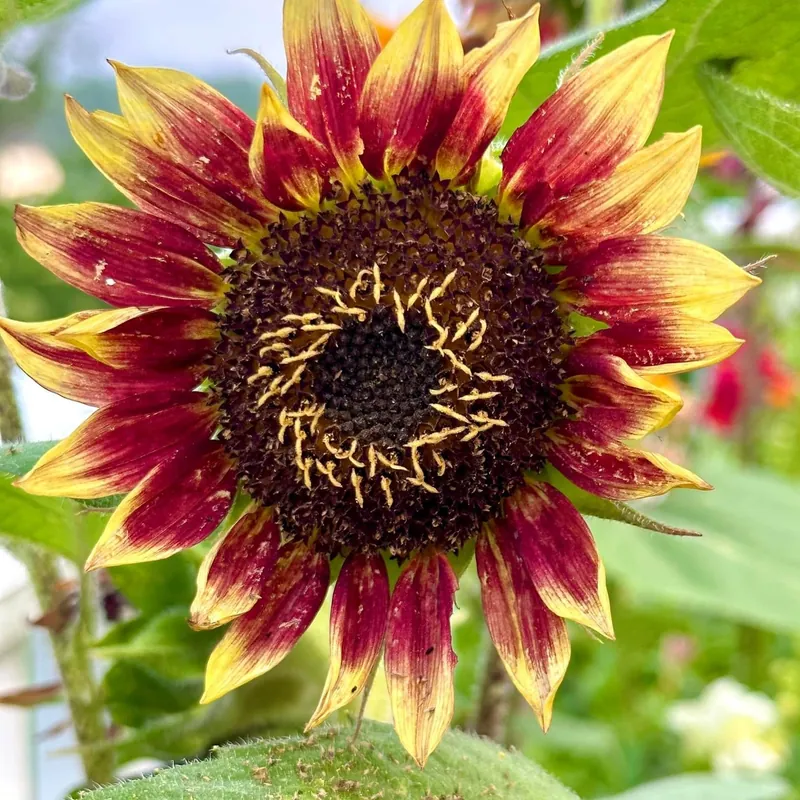
The common sunflower (Helianthus annuus) is a warm-season annual in the daisy family, native to the southwestern United States and Mexico and now grown, and naturalized, far beyond that. It grows fast from seed on a stiff, hairy, single stem with a taproot, from about 18 inches to 10 feet tall depending on the variety. Wild plants carry heads 3 to 6 inches across with orange-yellow rays around a dark brown or purplish center, from July to October. Garden varieties range from dwarf pot plants to giants such as 'Mongolian Giant', which NC State lists at 12 to 14 feet with heads 16 to 18 inches wide.
Breeding has also widened the colors. Besides yellow there are red, mahogany, bronze, white, and bicolor or tricolor sunflowers, with single or fully double heads. They are among the easiest flowers to grow from seed, they feed bees, butterflies and seed-eating birds, and the single-stem kinds make long-lasting cut flowers.
Sowing
Sunflowers do not tolerate frost and grow best at 70 to 85°F, so there is nothing to gain by sowing early.
- When: after the last frost, once the soil is at least 60°F. UGA Extension suggests waiting several weeks after the last frost. Find your date with our frost date lookup.
- How deep: about 1 inch (UGA says 1 to 2 inches, deeper in sandy soil). Seedlings come up in 7 to 10 days.
- Spacing: University of Minnesota Extension suggests about 6 inches for varieties 2 to 5 feet tall, at least a foot for taller ones, about 2 feet for giants and 18 to 24 inches for branching types.
- For a longer show: single-stem varieties give one flower per plant, so sow a few every 1 to 2 weeks, or plant several varieties with different bloom times at once. See succession planting.
Growing
Give sunflowers full sun and well-drained soil; extension services suggest a pH of 6.0 to 6.8. They put up with poor soil and, once established, dry spells. Minnesota Extension advises regular watering for about 20 days before and after flowering, which builds the roots that hold a tall plant with a heavy head. Dwarf and mid-size kinds rarely need support, but giants sometimes need a stout stake in windy spots; see supporting flowers.
Red and bicolor sunflowers
Most of the unusual colors are branching types, which carry many smaller heads over a long season. Johnny's Selected Seeds lists burgundy, chocolate, bronze and bicolor flowers in that group. Some to look for:
| Variety | Color | Notes |
|---|---|---|
| 'Velvet Queen' | Velvety red rays, chocolate center | Up to 5 feet (NC State) |
| 'Pastiche' | Deep yellow, orange-red and mahogany, bicolor and tricolor | Multi-stemmed, 4 to 5 feet (NC State) |
| 'Rouge Royale' ('Moulin Rouge') | Burgundy | Branching, pollenless, strong stems |
| 'Firecracker' | Bicolor | Short, sturdy plants |
| 'ProCut Red/Lemon Bicolor' | Red and lemon bicolor | Single stem |
| 'Strawberry Blonde' | Multicolored | Pollenless |
Many cut-flower sunflowers are pollenless hybrids: they drop no pollen on tablecloths and last up to two weeks in a vase. Johnny's notes that they still make plenty of nectar, so bees and butterflies visit, but they set seed only if sunflowers with pollen grow nearby. If you grow sunflowers for birds or for your own seed, choose a variety that makes pollen; UGA names the oilseed type 'Black Peredovik' as the best for wildlife.
Pollinators and birds
NC State calls sunflowers a late-season nectar source for monarchs and other butterflies, and the plant is a caterpillar host for the silvery checkerspot. The genus also supports specialist bees, including several mining bees (Andrena) and long-horned bees (Melissodes), that collect pollen mainly from sunflowers. None of the sources consulted list hummingbirds as visitors.
The seeds are the bigger draw. NC State and UGA Extension note that sunflowers attract seed-eating songbirds, and UGA's DeKalb County office names thistle and sunflower seed among the American goldfinch's favorite foods. Leave some heads standing into fall and winter for the birds; see leaving stems for wildlife.
Harvesting seed
Seed is ripe in early fall when the head nods, the back turns from green to yellow-brown and the small florets over the seeds dry and fall out. Cut the head with about a foot of stem and hang it in a warm, dry, airy place, out of reach of mice, to cure for several weeks before rubbing the seeds loose. Birds start on ripening heads early, so cover a few with paper bags or mesh if you want seed for yourself. See harvesting seeds from flowers.
Problems
- Deer: Rutgers rates sunflowers as occasionally severely damaged, and Minnesota and UGA warn that deer can quickly destroy young plants. NC State lists them as deer resistant, so expect results to vary with local deer pressure; see deer-resistant gardening.
- Insects: stink bugs, leaf-footed bugs, aphids and caterpillars feed on the plants, and slugs and snails eat seedlings. Go easy with sprays, since the flowers are full of pollinators.
- Diseases: powdery mildew, downy mildew, rust and leaf spots appear on the older leaves, usually late in the season; vigorous plants grow through them.
- Volunteers: plants self-seed readily, and dropped seed can come up as weeds the next year.
Sources
- Helianthus annuus, NC State Extension Gardener Plant Toolbox, accessed 2026: native range, size, temperatures, bloom season, colors, butterflies and specialist bees, silvery checkerspot, birds, problems, deer, 'Velvet Queen', 'Pastiche' and 'Mongolian Giant'
- Growing Sunflowers in the Home Garden, UGA Extension Circular 1121: soil temperature, pH, depth, spacing, deer, insects, diseases, oilseed types, seed harvest
- Sunflowers, University of Minnesota Extension: depth, germination, spacing by type, succession sowing, watering, staking, deer
- Choosing sunflower varieties, Johnny's Selected Seeds: single-stem and branching types, pollenless sunflowers and nectar, vase life, red and bicolor varieties
- Goldfinch sighting, UGA Extension DeKalb County, 2024: sunflower seed as a goldfinch food