Flowers ›
Cosmos
Cosmos bipinnatus
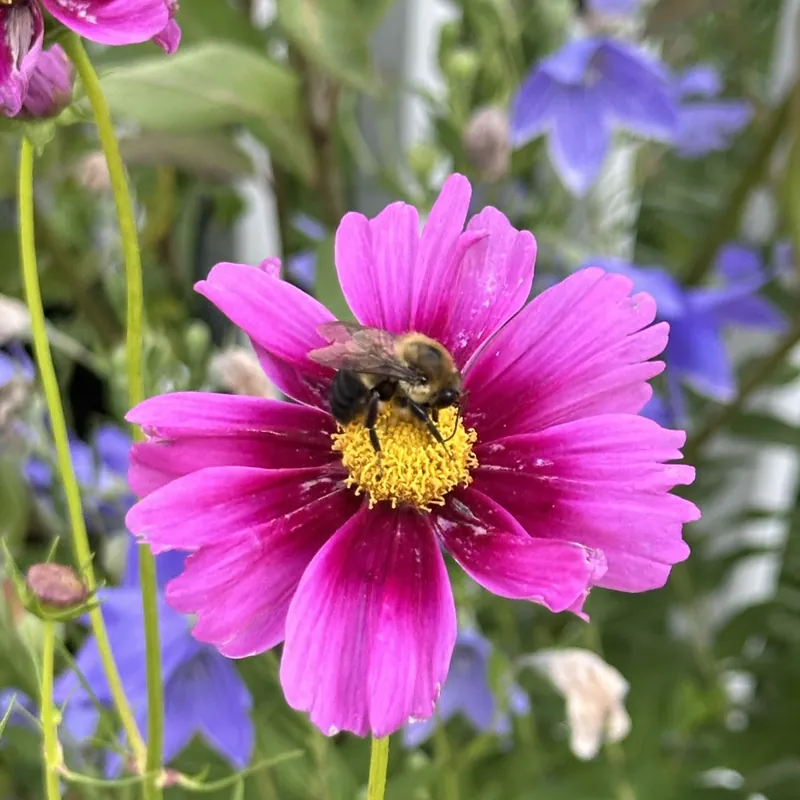
Cosmos (Cosmos bipinnatus), also called garden cosmos or Mexican aster, is a warm-weather annual in the daisy family, native to Mexico. It grows quickly on upright stems, usually 2 to 4 feet tall and 2 to 3 feet wide, with bright green leaves cut into fine, threadlike segments. From early summer until frost it carries single, saucer-shaped flowers 2 to 4 inches across, with pink, red, magenta or white rays around a yellow center. Cultivars add semi-double and double flowers, striped and edged petals, and heights from dwarf to tall.
It is one of the easiest flowers to grow from seed. Cosmos does best with little help: it prefers lean soil, takes heat and some dryness, and keeps flowering if you cut it. Bees and butterflies work the open flowers all season, and it makes a light, airy cut flower.
Sowing
- Direct sow after the last frost, when the soil has warmed to about 65°F or more. Find your dates with our frost date lookup.
- Rake the seed lightly into loose soil, about ⅛ inch deep. Seed buried too deep comes up poorly.
- Keep the soil moist until the seedlings are up, usually 7 to 21 days (faster in soil of 70 to 75°F).
- Indoors: start 6 to 8 weeks before the last frost if you want earlier flowers.
- Spacing: thin to 8 to 12 inches for most types. Tall plants set close together help hold each other up.
A second sowing in early summer gives fresh plants for late flowers; see succession planting.
Growing
Give cosmos full sun and average, well-drained soil. Sources agree that rich soil and fertilizer work against it. In fertile soil, or with too much water or fertilizer, plants grow tall and leafy and flower less. Skip manure and fertilizer in a cosmos bed.
- Water: even moisture is best, but established plants tolerate dry spells.
- Pinching: pinch out the growing tip when plants are about 18 inches tall for bushier plants with more flowers.
- Support: tall varieties can flop in strong wind. Plant them in a sheltered spot, close together, or give them support; see supporting flowers.
- Deadheading: cut spent flowers to keep new ones coming. Leave a few heads to ripen if you want plants to self-sow. In hot, humid summers plants may slow down in late summer.
Cut flowers often for the vase; cutting works the same way as deadheading.
Self-sowing
Cosmos drops plenty of seed and comes back on its own the next year if you leave a few flower heads to ripen. It has escaped gardens and naturalized along roadsides, fields and waste ground in many parts of the US, and NC State Extension describes it as aggressive and self-seeding. If you don't want volunteers, deadhead before the seeds ripen and pull seedlings in spring. To collect seed on purpose, see harvesting seeds from flowers.
Pollinators
Butterflies visit cosmos all season; Missouri Botanical Garden and Illinois Extension both list them among the plant's visitors. Bees come too: Oregon State Extension describes bumble bees resting on the flowers in the early morning and honey bees and long-horned bees foraging as the day warms. Illinois Extension also lists birds among its visitors.
Hummingbirds are not on the extension lists for cosmos; for them, grow tubular red flowers nearby, such as cardinal flower or firecracker plant. See building a butterfly garden for more butterfly plants.
Problems
Cosmos has no serious pest or disease problems in most gardens. NC State lists stem canker, powdery mildew and gray mold, along with aphids and aster leafhoppers. Deer browse cosmos at times: Rutgers rates it as occasionally severely damaged, so protect it where deer are heavy; see deer-resistant gardening.
Varieties
| Variety | Notes |
|---|---|
| Sensation series | Large pink, red and white flowers |
| 'Purity' | Pure white |
| 'Psyche' mix | 4 to 5 feet; lavender-pink or white |
| Seashells mix | About 3 feet; rolled, tube-like petals in red, pink and white |
| 'Picotee' | White with reddish-pink edges and yellow centers |
| 'Candy Stripe' mix | White petals with colored stripes |
| Gazebo mix | 3 to 4 feet; white, pink and red |
| 'Antiquity' | 1 to 2 feet, early flowering, 2-inch flowers |
| Sonata series | 1 to 2 feet; large pink, white or red flowers |
| Versailles series | Large red, white and pink flowers, good for cutting |
Sources
- Cosmos bipinnatus, Missouri Botanical Garden Plant Finder: native range, size, flowers, June to frost bloom, culture, indoor sowing, naturalizing, butterflies
- Cosmos bipinnatus, NC State Extension Gardener Plant Toolbox: sowing temperature, germination time, spacing, pests and diseases, self-seeding, cultivars
- Cosmos, University of Illinois Extension: low-fertility soil, overwatering and overfeeding, staking, deadheading, butterflies and birds
- Cheery garden cosmos, Oregon State University Extension: bees that visit cosmos
- How to grow cosmos, West Coast Seeds: sowing depth, germination temperature, spacing, pinching, poor soil