Flowers ›
Portulaca
Portulaca grandiflora
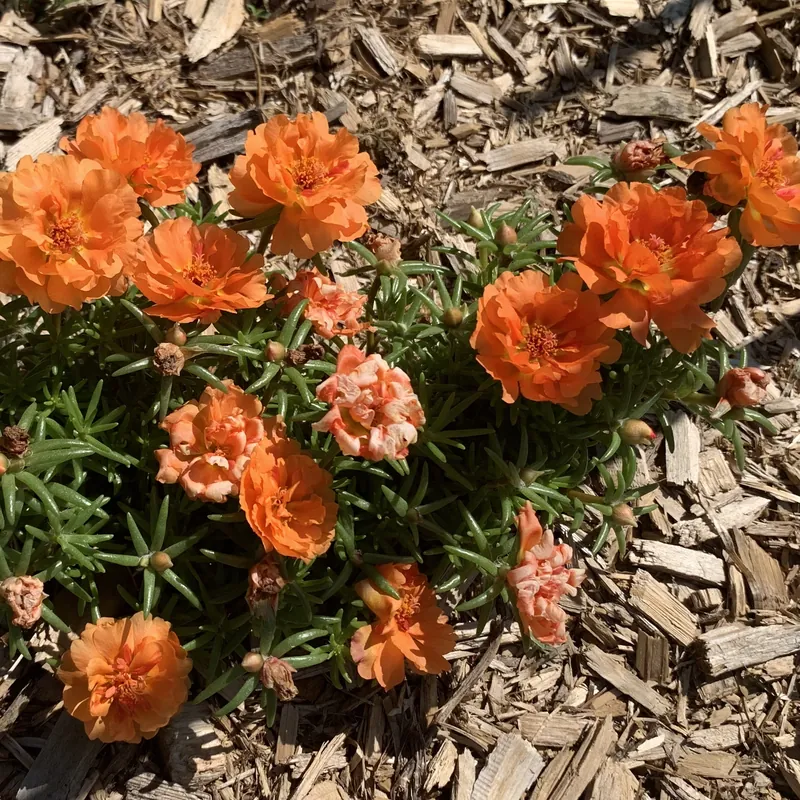
Portulaca, or moss rose (Portulaca grandiflora), is a low, spreading annual in the purslane family, native to the hot, dry plains of Argentina, southern Brazil and Uruguay. It is a succulent: the reddish, branching stems carry fleshy, cylindrical leaves about an inch long that store water between rains. Plants form a mat 3 to 8 inches high and about a foot across. From June until frost, the stem tips open into ruffled, saucer-shaped flowers 1 to 3 inches across, single or double, in red, rose, pink, orange, yellow, white, lavender and magenta, some striped or spotted.
It is the flower for the hottest, driest spot in the garden. Moss rose takes heat, drought and lean, sandy or rocky soil that would stunt most annuals, and it flowers all summer with almost no care. University of Arkansas Extension notes that it dates back to the early 1800s, when seed collected on the edge of the Argentine Pampas reached English gardens.
Sun-loving flowers
The flowers open in bright sun and close at night. On cloudy or rainy days the older types stay shut, and in nature they close by midday, according to University of Arkansas Extension. Breeders have worked on this for decades, and most newer varieties stay open all day; some, such as the 'Sundial' series, even open in cool, cloudy weather. If you want flowers in the afternoon and evening, check the variety description before you buy.
Sowing and planting
- When: moss rose is frost tender. Sow outdoors after the last frost once the soil is warm, or start seed indoors 4 to 8 weeks earlier (University of Wisconsin Extension; Missouri Botanical Garden gives 6 to 8 weeks).
- How: the seed is tiny. Mix it with sand to spread it evenly and barely cover it. University of Wisconsin Extension says it sprouts in about 1½ to 2 weeks.
- Transplants: NC State says seedlings do not transplant well and need careful handling. University of Arkansas Extension suggests sowing six to eight seeds per pot and moving the whole clump to the bed later.
- Spacing: thin seedlings to 3 inches or more apart.
- Light and soil: full sun and any well-drained soil, including poor, sandy, gravelly or rocky ground.
Care
Moss rose needs little. It survives drought, but University of Wisconsin Extension notes it grows and flowers more with adequate moisture and better soil. The one thing it will not take is wet ground: poorly drained soil causes crown, stem and root rot.
Pinching or deadheading increases flowering. If plants stop blooming or look straggly in midsummer, shear them back to remove the seed heads, and they will flower again. Broken stem pieces root in moist soil, so the trimmings can fill gaps.
Plants often self-seed. NC State and University of Arkansas Extension say it reseeds without becoming weedy in beds, and deadheading reduces seedlings. University of Wisconsin Extension notes that it has escaped to roadsides and waste places in parts of the country. To collect seed for next year, see harvesting seeds from flowers.
Problems
Missouri Botanical Garden reports no serious insect or disease problems. Aphids and slugs occasionally feed on it, and rot in wet soil is the main cause of failure. NC State lists moss rose as deer resistant, and University of Wisconsin Extension says deer generally avoid it (see the deer garden guide).
Toxicity
The ASPCA lists "moss rose" and purslane, under the name Portulaca oleracea, as toxic to dogs, cats and horses because of soluble calcium oxalates, with signs that include drooling, tremors and, rarely, kidney failure. It does not list P. grandiflora separately. NC State, on the other hand, says the flowers and seeds of P. grandiflora are edible. To be safe, keep pets from eating the plants. See poisonous garden plants for pets.
Varieties
Seed is sold as single colors and mixes, and some newer types are grown from cuttings. NC State and University of Wisconsin Extension describe these:
- 'Sundial' series: early, double flowers that open even in cool, cloudy weather.
- 'Happy Hour' series: early, with large double flowers.
- 'Sundance' series: semi-double flowers that stay open most of the day.
- 'Afternoon Delight': 2-inch flowers that stay open longer in the afternoon.
- 'Margarita' series: compact and mounding.
- 'Calypso Mix': bright double flowers.
- 'Fairy Tale' series: a pom-pom of petals in the center of flat outer petals.
- 'Yubi Summer Joy' series: single flowers nearly 3 inches across that stay open late in the day, on trailing plants.
Missouri Botanical Garden lists the 'Rio' series under purslane, Portulaca oleracea, a related plant with flat rather than cylindrical leaves; NC State lists it with moss rose.
Design ideas
- Hot, dry edges: along walks, driveways and the front of sunny beds.
- Rock gardens and walls: between stones and in wall crevices, though not where people walk.
- Over bulbs: University of Wisconsin Extension suggests it to cover the soil after spring bulb leaves die back.
- Pots and baskets: it trails over the edge. Pair it with zinnias or other heat-loving annuals (see container gardening).
Sources
- Portulaca grandiflora, NC State Extension Gardener Plant Toolbox, accessed 2026: native range, size, flowers, sun and soil, transplanting, self-seeding, edibility, deer resistance, cultivars.
- Portulaca grandiflora, Missouri Botanical Garden Plant Finder, accessed 2026: June to frost bloom, culture, sowing, problems, garden uses.
- Moss rose, University of Wisconsin-Madison Extension, accessed 2026: description, flower opening, sowing and germination, care, naturalizing, pests, cultivars, landscape uses.
- Moss rose, University of Arkansas Division of Agriculture, accessed 2026: history, sowing in pots, shearing, reseeding, breeding for longer opening.
- Moss rose, ASPCA Animal Poison Control, accessed 2026: listed under Portulaca oleracea as toxic to dogs, cats and horses.