Flowers ›
Mandevilla Red Riding Hood
Mandevilla sanderi 'Red Riding Hood'
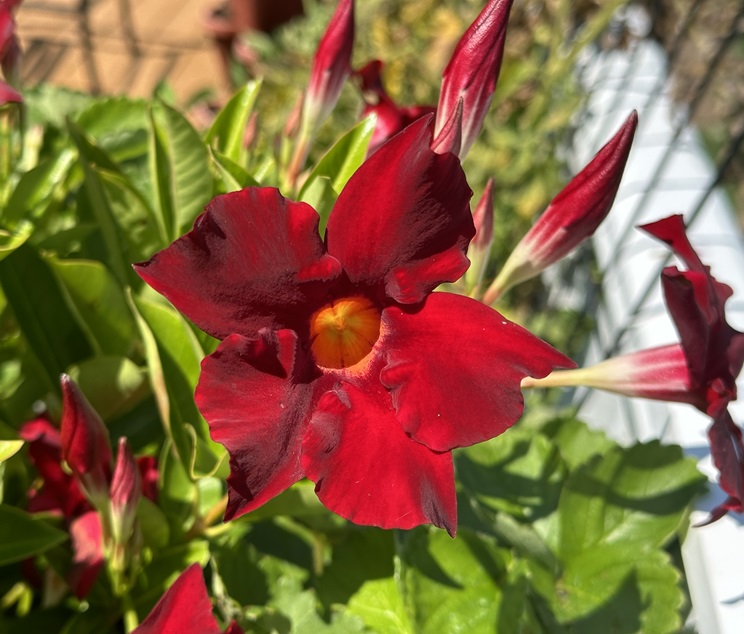
'Red Riding Hood' is a selection of Mandevilla sanderi, a twining vine from Brazil that is also sold under its old name, Dipladenia. It has funnel-shaped flowers in deep pink to red with a yellow throat, set against small, glossy, dark green leaves. It is bushier and more compact than the big-flowered mandevilla hybrids: the twining stems usually reach 6 to 8 feet where it grows year-round, and much less in a single summer in a pot. It flowers from late spring until the weather turns cool.
Hardiness
Mandevilla is a tropical perennial, hardy only in zones 10 and 11. Frost kills it, and it stops growing when nights drop below about 50°F. Everywhere else it is grown as a summer annual or brought indoors for the winter. Set plants out once nights stay above 50°F, usually a couple of weeks after your last frost date (look yours up with our zone and frost date lookup).
Growing it
- Light: full sun gives the most flowers in most of the US. In the hottest areas, afternoon shade helps.
- Soil and water: any well-drained soil, or a good potting mix in containers. Let the top inch dry out between waterings. It handles a short dry spell, but a pot in full summer sun may need water every day. Soggy soil rots the roots.
- Feeding: a balanced liquid fertilizer every two weeks from late spring to late summer, or a slow-release fertilizer at planting.
- Support: give the stems a trellis, obelisk or railing to twine around, or let them trail from a hanging basket or window box. Pinch the tips of young plants to make them branch.
It suits container growing well, which is also the easiest way to keep it from year to year.
Overwintering
Bring the plant in before nights fall below 50°F. Check the leaves and stems for mealybugs, spider mites and whiteflies first, since those are the pests that build up indoors. You then have two options:
- Grow it as a houseplant in your sunniest window, watering only when the top of the soil is dry. Expect some leaf drop.
- Cut it back by about half and keep it nearly dry in a cool, bright room (around 55 to 60°F) until spring, then move it to warmth and light and resume watering.
Either way, wait until nights are reliably warm again before moving it back outside.
Wildlife and safety
Hummingbirds visit the tubular flowers; butterflies only occasionally. Deer and rabbits usually leave mandevilla alone. Cut stems bleed a milky sap that can irritate sensitive skin, so wear gloves when pruning.