Flowers ›
Meadow Rue
Thalictrum aquilegifolium
- Life cycle
- Perennial
- Growth form
- Upright
- Hardy to zone
- 4
- Light
- Part Shade
- Moisture
- Moist
- Soil
- Loam
- Height
- 36 in (3 ft)
- Spread
- 18 in
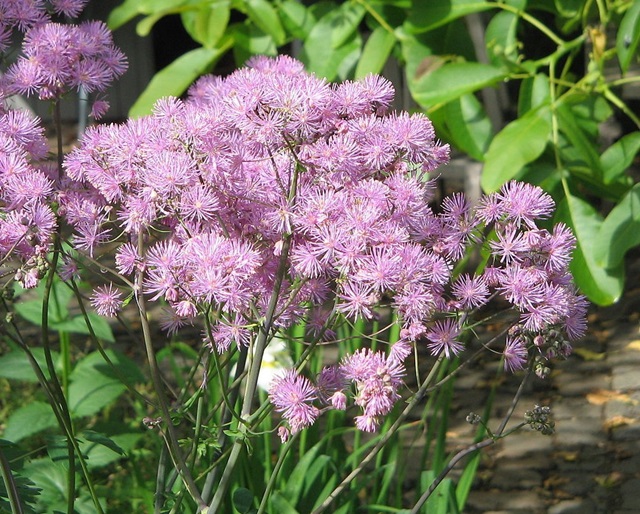
Columbine meadow rue (Thalictrum aquilegifolium) is a clump-forming perennial in the buttercup family, native to Europe and northern Asia. It gets its name from its blue-green leaves, which are divided like those of columbine. In late spring and early summer, stiff stems carry loose, domed clusters of flowers above the foliage. The flowers have no real petals: the fluffy look comes from masses of stamens in lilac, pink, purple or white. Plants grow 2 to 3 feet tall and 1 to 1½ feet wide.
Other meadow rues are worth knowing. Thalictrum rochebrunianum 'Lavender Mist' grows 5 to 6 feet tall and flowers later, in mid to late summer. Several species are native to eastern North America, including early meadow rue (T. dioicum) in woodlands and tall meadow rue (T. pubescens) in wet meadows.
Growing conditions
- Light: part shade is best, especially where summers are hot. In the North it takes full sun as long as the soil stays moist.
- Soil and water: humus-rich soil that stays evenly moist but drains well. It does not like drying out; in a dry summer the leaves brown and the plant may go dormant early. A layer of mulch and watering in dry spells prevent that. Our guide to building healthy soil covers adding organic matter.
- Hardiness: zones 4 to 8.
- Spacing: 12 to 18 inches.
Care
This species usually stands without staking, though the taller meadow rues need support. Cut off the flower heads after bloom if you don't want seedlings, or leave a few: the seed heads are decorative and it self-sows in moderation. If the foliage looks tired by late summer, cut it back. Established plants dislike being disturbed, so raise new plants from seed rather than dividing. Powdery mildew is the most common problem, mainly in dry soil.
It pairs well with other shade plants for moist soil, such as ferns, hostas, bleeding heart and foxglove.
Wildlife
The flowers offer pollen but little or no nectar. Bees and hoverflies collect the pollen; butterflies and hummingbirds have little reason to visit. Deer and rabbits usually leave meadow rue alone.