Plants per Foot in Square Foot Gardening Method
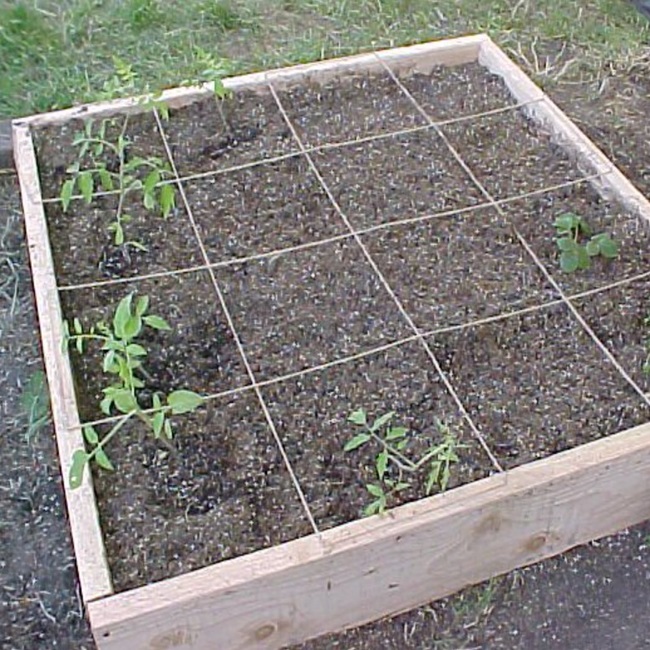
In square foot gardening, each 1-foot square holds 1, 4, 9 or 16 plants, depending on how big the plant gets. That works out to the following spacing:
- 1 per square: one plant in the center, 12 inches apart. Large plants such as tomatoes, peppers and broccoli.
- 4 per square: a 2-by-2 grid, 6 inches apart. Medium plants such as leaf lettuce, chard and parsley.
- 9 per square: a 3-by-3 grid, 4 inches apart. Beets, bush beans, spinach, onions.
- 16 per square: a 4-by-4 grid, 3 inches apart. Carrots, radishes, green onions.
An easy way to mark the spots is to press your fingertips into the soil in an even grid, then drop one or two seeds in each hole and thin to the strongest seedling.
| Vegetable or herb | Plants per square | Notes |
|---|---|---|
| Asparagus | 1 | Perennial that stays 15 years or more; give it its own bed |
| Basil | 4 | Large varieties at 1 or 2 per square |
| Beets | 9 | Each seed is a cluster; thin to one seedling |
| Bell peppers | 1 | |
| Broccoli | 1 | |
| Brussels sprouts | 1 | Tall; place on the north side |
| Bush beans | 9 | |
| Cabbage | 1 | |
| Carrots | 16 | Needs loose soil deeper than 6 inches for long varieties |
| Cauliflower | 1 | |
| Celery | 4 | |
| Chives | 9 | Perennial |
| Cilantro | 4 | |
| Corn | 4 | Plant a block of at least 4 squares for good pollination. Very tight; expect small ears (see below) |
| Cucumbers (trellised) | 2 | Along a trellis on the north side |
| Dill | 1 | Grows 3 feet tall or more |
| Eggplant | 1 | |
| Garlic | 9 | Plant cloves in fall |
| Green onions | 16 | |
| Kale | 1 | |
| Leeks | 9 | |
| Lettuce (leaf) | 4 | Head lettuce at 1 per square |
| Melons (trellised) | 1 | Small-fruited varieties; support fruit in slings |
| Onions (bulb) | 9 | |
| Parsley | 4 | |
| Peas (trellised) | 8 | Two rows of 4 along a trellis |
| Pole beans (trellised) | 8 | Two rows of 4 along a trellis |
| Potatoes | 1 | Needs a deeper bed or hilling; 6 inches of soil is not enough |
| Radishes | 16 | |
| Spinach | 9 | |
| Summer squash (bush) | 1 plant per 4 to 9 squares | Bush plants spread 2 to 3 feet or more |
| Sweet potatoes | 1 | Vines run several feet; let them trail out of the bed |
| Swiss chard | 4 | |
| Thyme | 4 | Perennial |
| Tomatoes (staked) | 1 | Indeterminate types pruned to a single stem on a stake or trellis. Unpruned, caged or bush (determinate) plants need about 4 squares |
| Turnips | 9 | |
| Zucchini | 1 plant per 4 to 9 squares | A single plant easily fills a 3-by-3-foot area |
These are starting points, not rules. Compact or dwarf varieties can go closer; vigorous ones need more room. If a crop looks crowded, with poor air movement and small yields, give it more space the next time you plant it.
Where the method is tighter than usual
The chart follows the square foot method. For small crops it roughly matches the equal-distance spacing that extension services give for intensive beds. For the large ones it is tighter. Virginia Cooperative Extension's intensive spacing chart, for comparison, gives:
- Tomatoes, eggplant, melons and summer squash: 18 to 24 inches
- Sweet corn, cabbage, cauliflower, Brussels sprouts and kale: 15 to 18 inches
- Broccoli and cucumbers: 12 to 18 inches
- Peppers: 12 to 15 inches
At one plant per square these crops still grow, but heads and ears are smaller, leaves stay wet longer, which favors leaf diseases, and the plants need more water and feeding. Corn at four per square is more than six times as dense as that chart allows. If you have the room, give the big crops two squares each, or alternate them with a low crop such as lettuce or radishes that is harvested before they fill out.
Plant cool-season crops from about 4 to 6 weeks before your last frost and warm-season crops after it; look up your dates with the zone and frost date lookup. For bed construction and soil, see raised bed gardening.
Sources
- Intensive Gardening Methods (426-335), Virginia Cooperative Extension, 2023