Flowers ›
Snapdragon
Antirrhinum majus
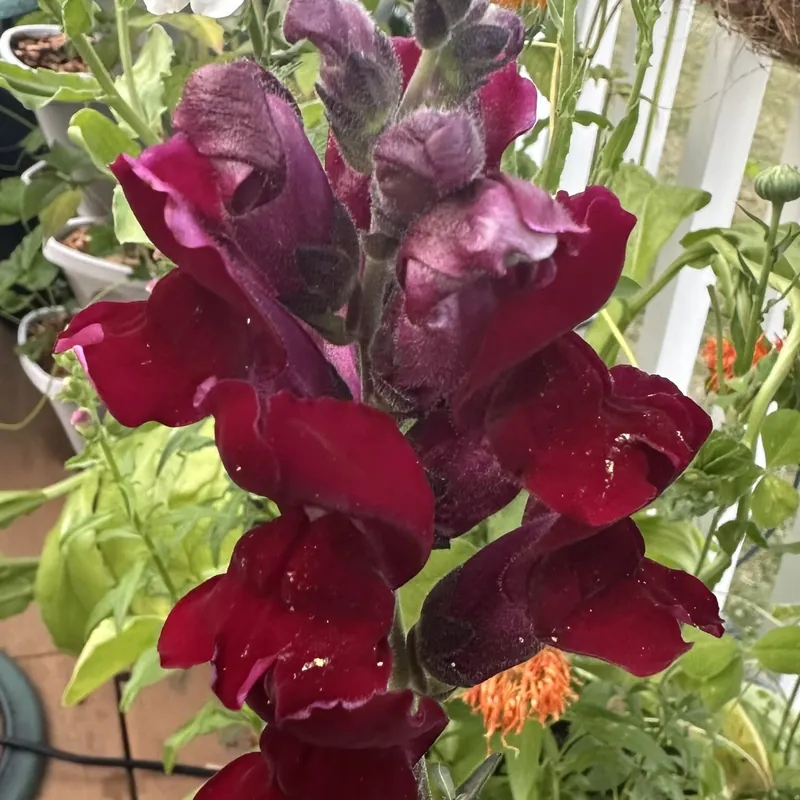
Snapdragon (Antirrhinum majus) is an old garden favorite in the plantain family, native to southwestern Europe and the Mediterranean, where it lives as a short-lived perennial. In most American gardens it is grown as an annual. Plants are upright, with glossy, dark green, lance-shaped leaves about 3 inches long, and they carry their flowers in tall spikes. Each flower is a tube with two lips, the lower one closing the throat, in a shape said to look like a dragon's snout. Colors run through white, yellow, orange, peach, pink, red and purple, plus many bicolors.
Snapdragons are among the best flowers for cool weather. They go out early in spring, flower from spring to fall where summers are mild, and come back strong in autumn after a summer lull. Dwarf types edge a bed or fill a window box; tall types are a classic cut flower. Bumblebees are the flower's natural partners, and hummingbirds visit too.
Hardiness
Snapdragon is a tender perennial, hardy in zones 7 to 10 (Missouri Botanical Garden, NC State Extension). Missouri Botanical Garden notes that well-mulched plants in protected spots sometimes survive the winter even in St. Louis, but most gardeners replace them each spring because plants are inexpensive. The RHS rates the species only H2, damaged by hard freezes, so don't count on plants coming back. South of zone 7, Missouri Botanical Garden says snapdragons are often planted in fall to flower through the winter. Look up your zone on the garden zones page.
Sowing and planting
- Indoors: start seed 6 to 10 weeks before the last spring frost (Missouri Botanical Garden; Nebraska Extension gives 8 to 10 weeks). Find your dates with our frost date lookup.
- Light for seed: Nebraska Extension says the tiny seed needs light to germinate, so press it onto the surface rather than covering it. It germinates in 2 to 3 weeks at 55 to 60°F, and cooler conditions give shorter, sturdier seedlings.
- Planting out: snapdragons are cold tolerant. Nebraska Extension suggests planting them early in spring alongside pansies and violas.
- Site: full sun to light shade, in moist, organically rich soil that drains well. Nebraska Extension suggests adding organic matter to heavy clay.
Choose rust-resistant seed or plants where you can; Missouri Botanical Garden recommends it.
Care
- Water: keep the soil evenly moist and water at the base rather than overhead (Missouri Botanical Garden, NC State).
- Pinching: pinch the tips of young plants to make them bushier.
- Deadheading: cut off spent spikes to keep new ones coming.
- Summer slump: plants often slow down in hot weather. Missouri Botanical Garden suggests cutting them back hard and fertilizing if flowering drops off after the first flush; Nebraska Extension adds steady watering and weekly feeding.
- Support: tall types can be top-heavy and need staking while young; see supporting flowers.
Snapdragons make good cut flowers, and cutting does the same job as deadheading.
Snapdragon rust
The RHS calls rust the most serious disease of snapdragons. University of Minnesota Extension describes yellow spots on the upper leaf surface with raised brown pustules underneath, often in rings, that release powdery reddish-brown spores. Badly infected leaves die, and plants can be stunted and stop flowering. Minnesota notes that it develops in cool weather, and the RHS says it builds quickly in wet conditions and spreads on the wind.
What helps:
- Pick off infected leaves early and clear away plants and debris at the end of the season (RHS).
- Water at the soil, not over the leaves.
- Grow snapdragons in a different spot the next year if rust appears (Missouri Botanical Garden).
- Grow rust-resistant types. The RHS names Coronette, Monarch and Tahiti series but warns that the fungus can adapt and overcome resistance.
Other problems
Missouri Botanical Garden and NC State also list mold, fungal leaf spots, downy mildew, wilt and root rots, and Missouri Botanical Garden mentions aphids. Deer seldom bother snapdragons: Rutgers rates Antirrhinum majus as rarely damaged, and Nebraska Extension says deer and rabbits generally pass them by, which makes them useful in a deer-prone garden.
Pollinators
Missouri Botanical Garden and NC State list snapdragon as attracting hummingbirds and butterflies, and the RHS lists it as a plant for pollinators. Nebraska Extension says the flowers attract hummingbirds, bumble bees and other larger bees, but are not a preferred honey bee plant because a bee must push between the lips to reach the pollen. NC State describes the same thing: bees land on the lower lip and push it open to get at the nectar.
Pets and people
The ASPCA lists snapdragon as non-toxic to dogs, cats and horses. NC State notes that the flowers are edible but bitter, best used as a garnish.
Varieties
Missouri Botanical Garden groups snapdragons by height: dwarf (8 to 12 inches) for edging, window boxes and containers; intermediate (12 to 24 inches) for beds and borders; and tall (24 to 36 inches) for the back of the border and cutting. Nebraska Extension names series in each group:
| Group | Series |
|---|---|
| Dwarf, 6 to 10 inches | Floral Showers, Floral Carpet, Magic Carpet, Tahiti |
| Intermediate, 16 to 24 inches | Chimes, Crown, Freesong, LaBella, Montego, Snaptastic |
| Tall, 24 to 30 inches and up | Panorama, Rocket, Sonnet |
| Trailing | Candy Showers, for hanging baskets and window boxes |
Design ideas
- Cool-season beds: with stock, rocket larkspur and pansies in spring, and again in fall.
- Containers: dwarf and trailing types in pots and hanging baskets; see container gardening.
- Cutting garden: tall series in a row of their own, staked early.
Sources
- Antirrhinum majus, Missouri Botanical Garden Plant Finder, accessed 2026: native range, zones 7 to 10, size, bloom months, colors, indoor sowing, pinching, cutting back, overwintering, fall planting in the South, height groups, rust and other problems, hummingbirds and butterflies.
- Antirrhinum majus, NC State Extension Gardener Plant Toolbox, accessed 2026: life cycle, zones, soil and watering, bee pollination, edible flowers, wildlife, diseases.
- 2019 the year of the snapdragon, Nebraska Extension in Lancaster County, accessed 2026: seed needs light, germination temperature, cold tolerance, summer care, bees and hummingbirds, deer and rabbits, series by height.
- Snapdragon rust, University of Minnesota Extension, and Antirrhinum rust, Royal Horticultural Society, accessed 2026: symptoms, conditions, control, resistant series.
- Common snapdragon, ASPCA Animal Poison Control, accessed 2026: non-toxic to dogs, cats and horses.