Flowers ›
Million Bells
Calibrachoa × hybrida
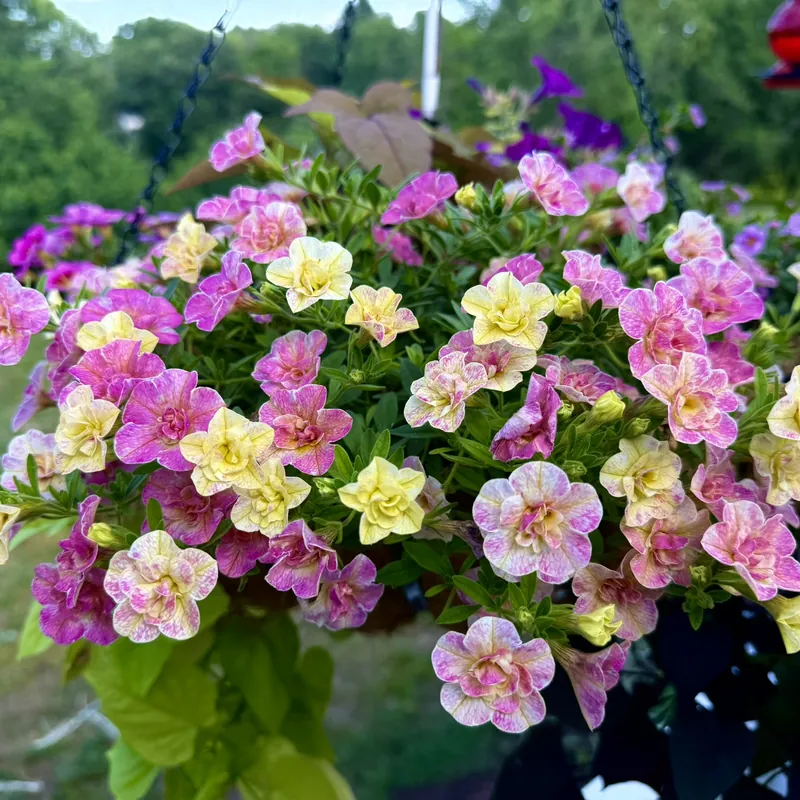
Million bells (Calibrachoa, mostly hybrids sold as Calibrachoa × hybrida) is a close relative of the petunia in the nightshade family. The genus is native to South and Central America, and garden calibrachoas were introduced in the 1990s. Plants form low mounds 3 to 12 inches tall with stems that trail to 2 feet, and from late spring until frost they are covered in hundreds of funnel-shaped flowers about an inch across. Colors include violet, blue, pink, red, magenta, yellow, orange, bronze and white, often with a contrasting eye or veins. It is sometimes sold as trailing petunia or mini petunia.
It is a tender perennial, hardy only in zones 9 to 11, so most gardeners grow it as an annual. Million bells is at its best in hanging baskets, window boxes and containers, where the stems spill over the edge. It needs no deadheading, since spent flowers drop on their own, and unlike many petunias it keeps flowering through summer heat.
Planting
- When: set plants out after the last frost, once the soil is above about 55°F. Find your date with our frost date lookup.
- Light: full sun, at least 6 to 8 hours. In part shade plants stretch, the leaves turn pale and flowering drops.
- Mix: a well-drained potting mix with plenty of organic matter. Garden soil usually drains too slowly, which is why calibrachoa does better in containers than in beds. Every pot and basket needs drainage holes.
- pH: calibrachoa likes slightly acid conditions, about pH 5 to 6.5. In a higher pH it cannot take up enough iron.
- Pinch: clip the top 2 inches of the stems at planting for a fuller plant.
Calibrachoa produces little or no seed, so plants are bought in spring or grown from cuttings. Most named varieties are patented, which means they may not be propagated for sale.
Watering and feeding
The two things that matter most are steady feeding and not overwatering.
- Water when the top of the mix feels dry, then water thoroughly until it drains from the bottom. Baskets in sun may need water every day in midsummer, but the mix should never stay soggy. Calibrachoa is sensitive to wet roots.
- Feed often. It is a heavy feeder: mix a slow-release fertilizer into the potting mix at planting, then use a water-soluble fertilizer every week or two from midsummer on. A balanced fertilizer is enough; extra phosphorus does not give more flowers.
- Yellow new leaves with green veins usually mean the plant is short of iron, often because the pH is too high. Keep feeding, and use a fertilizer or supplement that contains iron.
- Trim leggy or stretched plants back 1 to 4 inches in summer to make them branch again.
See container gardening for more on pots and potting mixes.
Hardiness and overwintering
Missouri Botanical Garden lists million bells as hardy in zones 9 to 11, while NC State lists zones 7 to 11, so it may live through mild winters in the South. Elsewhere frost kills it. Because named varieties are patented, the usual approach is to buy new plants each spring; the University of Minnesota describes rooting 6-inch stem cuttings in water in 3 to 4 weeks for your own use.
Problems
Missouri Botanical Garden reports no serious insect or disease problems. The one to watch for is root rot from too much water: a plant that wilts while the mix is wet has usually lost its roots. Aphids, spider mites and thrips sometimes feed on the plants, rarely seriously. Some cultivars, such as 'SuperCal', are prone to phytophthora root and stem rot. NC State says deer do not seem very interested in calibrachoa but does not class it as deer resistant; see deer-resistant gardening.
Varieties
| Series or variety | Notes |
|---|---|
| Million Bells | The original series name; 'Terra Cotta' has orange flowers streaked with red and gold |
| Superbells | Large range of colors; 'Lavender' has stems up to 36 inches, 'Pomegranate Punch' is red with a darker center |
| Cabaret | 'Good Night Kiss' placed in the top two of the 2019 NC State trials and was a Minnesota Top Ten |
| Kabloom | 'Light Pink Blast' placed first in the 2019 NC State trials |
| MiniFamous | Includes double-flowered kinds such as 'Double Blue' |
| Callie | Small flowers in apricot, deep yellow, scarlet and white |
Pollinators
Both Missouri Botanical Garden and NC State list hummingbirds among the visitors to calibrachoa, and the small tubular flowers, borne all summer, make a hanging basket a good hummingbird stop near a window or porch. Neither source lists butterflies. For a stronger hummingbird planting, add red tubular flowers such as fuchsia or firecracker plant; see cardinal flowers and hummingbirds.
Sources
- Calibrachoa (group), Missouri Botanical Garden Plant Finder: zones 9 to 11, size, June to frost bloom, colors, culture, no seed, patents, heat, hummingbirds, no serious problems, baskets
- Calibrachoa × hybrida, NC State Extension Gardener Plant Toolbox: native range, zones 7 to 11, size, feeding, root rot, pests, phytophthora, deer, hummingbirds, cultivars and 2019 trial results
- Growing calibrachoa, University of Minnesota Extension: introduction in the 1990s, size, sun, soil temperature, potting mix, watering, feeding, pH, pinching, cuttings, trial results
- Truly super Superbells, Proven Winners: sun, watering, fertilizer ratios, iron and pH, trimming, root rot