Flowers ›
Spider Flower
Cleome hassleriana
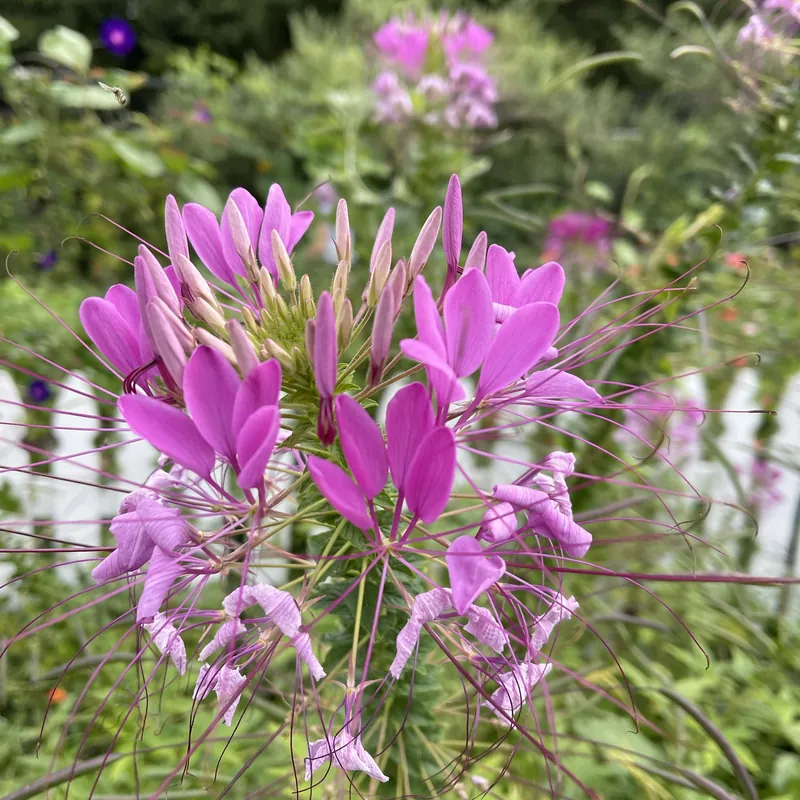
Spider flower (Cleome hassleriana, now often listed as Cleome houtteana, and also called cleome or spider plant) is a fast-growing annual from South America: Argentina, Paraguay, Uruguay and southern Brazil. It grows on a stout taproot to 3 to 6 feet tall, with hand-shaped leaves of five to seven leaflets. From June until frost it carries rounded heads of pink, rose, purple or white flowers at the top of each stem. Each flower has four petals and six stamens up to 3 inches long, and those long stamens, sticking out like legs, give it its name.
It has been grown in gardens since the 1800s and earns its place at the back of a border: tall, airy color all summer in heat and dry spells, on a plant deer and rabbits generally avoid. Hummingbirds, bees and butterflies visit the flowers, and hummingbird moths come at dusk.
Sowing
- Direct sow after the last frost, once the soil has warmed. Clemson Extension suggests waiting for soil of 70 to 75°F. Find your dates with our frost date lookup.
- Sow thinly and cover with about ¼ inch of soil. Keep it moist but not wet; seedlings come up in 7 to 14 days.
- Indoors: start 6 to 8 weeks before the last frost and plant out after it.
- Thinning: thin to 10 to 15 inches apart for most varieties; give bushy types up to 3 feet. Crowded seedlings grow weak and spindly.
- Chilling: Clemson notes that Queen series seed comes up better after 4 to 5 days in the refrigerator; Sparkler seed doesn't need it.
- Plants start flowering 70 to 80 days after the seed sprouts.
Seed stays viable for about a year in storage, then germination falls off.
Growing
Give spider flower full sun to light shade and average, well-drained soil. It tolerates heat, humidity and dry spells, but grows and flowers better with water during a drought. Too much water or fertilizer makes tall, leggy plants.
The strong taproot usually holds it up without staking, except in windy spots. Pinching young plants gives a shorter, bushier plant. Deadheading isn't needed. The lower stems often go bare later in summer, so plant shorter annuals in front, and plant cleome in groups 2 to 3 feet across rather than single plants.
Wear gloves when handling the older types. Their stems have small spines at the base of each leaf stalk, and the leaves are sticky with glandular hairs that give off a musky, faintly skunk-like smell. Most newer cultivars are thornless and odorless.
Self-seeding
After each flower fades, a long, thin seedpod forms on its own stalk. The pods ripen to brown and split, and the older types, such as the Queen series, self-sow heavily. To keep volunteers down, remove pods before they ripen or spread a thick mulch the next spring. Seedlings of named varieties don't come true, and after a few generations they drift toward pale pink. Spider flower has naturalized in some areas but is not generally considered invasive, since it rarely persists in undisturbed ground.
To save seed on purpose, pick pods as they begin to turn yellow and let them dry; see harvesting seeds from flowers. The sterile hybrids, such as the Señorita series, make no seed.
Pollinators
NC State Extension lists spider flower as attracting bees, butterflies, hummingbirds and moths, and Clemson notes the hummingbird moths that visit at dusk. In its native range bats are thought to be the main pollinators. It is a good plant for the back of a butterfly garden or a hummingbird bed, behind shorter nectar plants such as zinnia and pentas.
Problems
Spider flower has few serious problems. Aphids, spider mites and whiteflies show up now and then, and flea beetles and caterpillars sometimes chew the leaves. In hot, humid weather rust and powdery mildew can appear; space plants for good air flow, and pull dead plants after frost to reduce disease the following year.
Varieties
| Variety | Height | Notes |
|---|---|---|
| Queen series | 3 to 5 feet | The tall classic in cherry, rose, violet, white and lilac; self-sows freely |
| 'Helen Campbell' | About 4 feet | Fragrant white flowers |
| Sparkler series | 2 to 3 feet (Sparkler 2.0 to 44 inches) | F1 hybrids, bushy; blush, lavender, rose, purple and white |
| Señorita series | 2 to 4 feet | Thornless, odorless, not sticky, sterile; includes 'Rosalita', 'Blanca' and 'Mi Amor' |
| Spirit series | 2 to 4 feet | Branching; 'Appleblossom' opens pale pink and fades to white; can self-sow |
| 'Linde Armstrong' | 12 to 24 inches | Compact, pink, thornless and sterile |
Sterile types are sold as plants, since they don't set seed.
Sources
- Cleome hassleriana, NC State Extension Gardener Plant Toolbox: current name, native range, size, flowers, wildlife, deer and rabbit resistance, pests and diseases
- Spider flower, Cleome hassleriana, University of Wisconsin Extension: taproot, spines and odor, seedpods and seed saving, self-seeding and naturalizing, wildlife including bats, cultivars
- Cleome or spider flower, Clemson Cooperative Extension: sowing temperature and depth, thinning, chilling Queen seed, days to bloom, care, sterile hybrids, pests and diseases, cultivars