Flowers ›
Lamb's Ear
Stachys byzantina
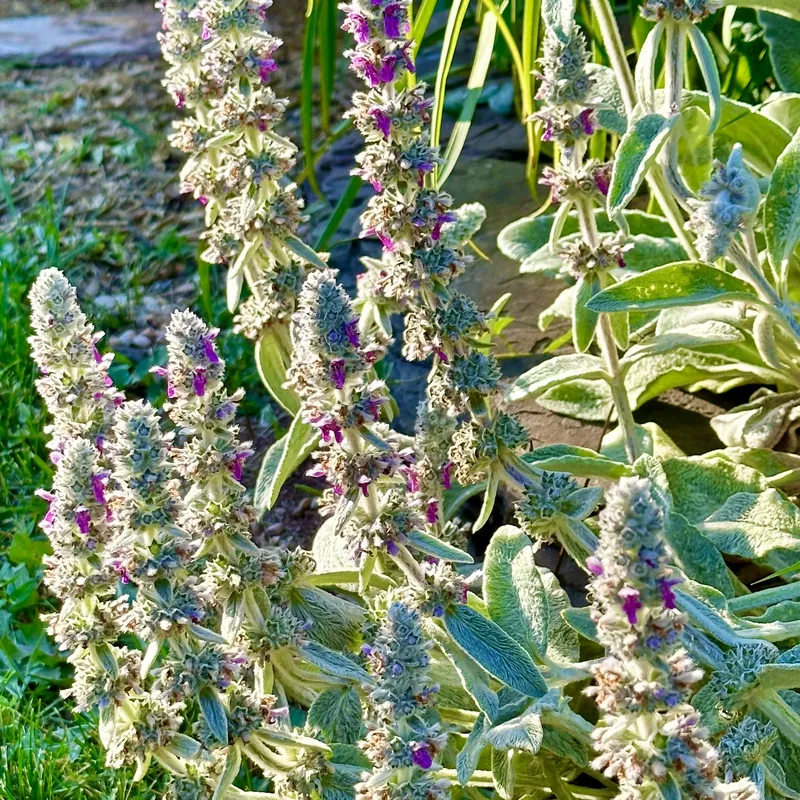
Lamb's ear (Stachys byzantina) is a low perennial in the mint family, native to the rocky hills of Turkey, the Caucasus and Iran. It is grown above all for its leaves: tongue-shaped, up to 4 to 6 inches long, thick and covered in dense white wool that makes them silvery and as soft as felt, which is where the common name comes from. Plants form a mat about 4 to 6 inches high that spreads by creeping stems rooting along the ground. From May to July many plants send up woolly flower stalks 10 to 20 inches tall, set with whorls of small purplish-pink flowers.
Few plants give such a strong silver color and soft texture, and lamb's ear does it in dry, poor, sunny spots where many perennials struggle. NC State suggests it for sensory and children's gardens, where its leaves invite touching. Deer and rabbits leave it alone. Its weaknesses are humidity and wet soil, which can rot the woolly leaves in a hot, damp summer.
Planting
- Light: full sun. In hot summers some afternoon shade helps, but Missouri Botanical Garden warns that too much shade keeps the leaves from drying and encourages disease.
- Soil: average to poor, dry to medium, and above all well drained. NC State says it tolerates clay, loam, sand and shallow rocky soil, and suggests planting on a slope in hot, humid areas to prevent root rot.
- Hardiness: zones 4 to 8 (Missouri Botanical Garden); NC State gives 4 to 9. Look up your zone on the garden zones page. Leaves stay evergreen in mild climates but look battered after a harsh winter.
- Spacing: 12 to 18 inches apart as a ground cover.
Care
Once established, lamb's ear is drought tolerant and should not be overwatered. Missouri Botanical Garden explains that the woolly leaves trap moisture, so water at the soil rather than over the plant.
Many gardeners cut off the flower stalks as they appear. Missouri Botanical Garden and NC State both note that removing them keeps the plant compact and puts the attention on the leaves. Leave some if you want them for bees, then cut them down when they fade.
In humid weather some leaves may rot or develop leaf spot, and patches can die out in midsummer. Missouri Botanical Garden advises removing damaged leaves when this happens. Divide clumps every 2 to 4 years, as NC State suggests, to renew them and control their spread.
Spreading
Lamb's ear spreads by rooting stems and can be mildly aggressive in rich soil; NC State calls it aggressive in good conditions. It makes a good ground cover for a small area or a path edge where it has room. If you do not want seedlings, removing the flower stalks also stops seed.
Pollinators
NC State lists lamb's ear as attracting butterflies and other pollinators. The plant has an unusual partner: the wool carder bee. Ohio State University Extension describes how female wool carder bees scrape the fuzzy hairs off lamb's ear leaves with their mandibles and carry them home to line their nests in old beetle tunnels and hollow stems. The larger males hover over lamb's ear patches and bump other insects away, but they cannot sting. The flowers are not shaped for hummingbirds, so it scores low for them here.
Deer and rabbits
Rutgers rates Stachys byzantina as rarely damaged by deer, and Missouri Botanical Garden and NC State list it as tolerant of both deer and rabbits. That makes it a good edging for a deer-prone garden.
Varieties
- 'Helene von Stein' (also sold as 'Big Ears'): larger leaves, better tolerance of summer heat, and it rarely flowers. Missouri Botanical Garden calls it the best of the cultivars.
- 'Silver Carpet': rarely blooms, for a neat ground cover.
- 'Cotton Boll': flowers look like small cotton balls along the stem.
- 'Primrose Heron': yellow leaves in spring and pink flowers.
- 'Striped Phantom': variegated leaves.
The non-flowering forms are the best choice where you want a tidy silver carpet.
Design ideas
- Edging: a soft silver line along a walkway or the front of a border.
- With dark flowers: silver leaves set off deep reds and purples, such as knautia, salvia 'Blue Monday' or catmint.
- Dry and rock gardens: with yarrow, sedum and other drought-tolerant plants.
- Containers: NC State lists it for container planting; give it a gritty, free-draining mix (see container gardening).
Sources
- Stachys byzantina, Missouri Botanical Garden Plant Finder, accessed 2026: native range, zones 4 to 8, size, bloom months, culture, humidity and rot, spreading, flower removal, deer and rabbit tolerance, 'Helene von Stein'.
- Stachys byzantina, NC State Extension Gardener Plant Toolbox, accessed 2026: zones 4 to 9, soils, slope planting, leaf size, butterflies and pollinators, deer and rabbit resistance, division, cultivars, uses.
- Beneficial insects: wool carder bees, Ohio State University Extension, Buckeye Yard and Garden Line, accessed 2026: wool carder bees collecting lamb's ear hairs, male territorial behavior.