Flowers ›
Canterbury Bells
Campanula medium
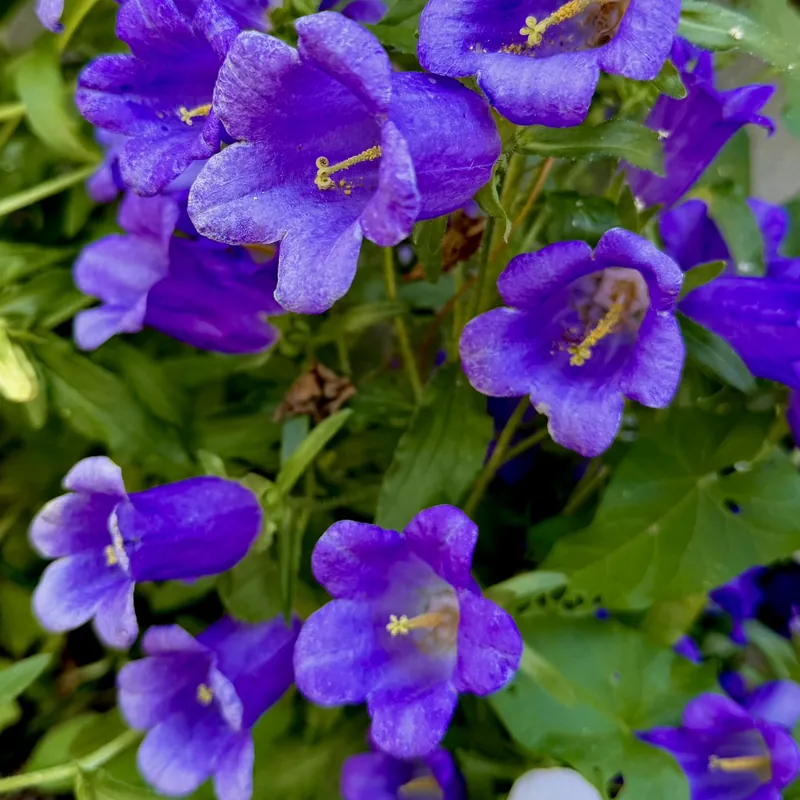
Canterbury bells (Campanula medium) is a classic cottage-garden biennial, native to rocky slopes in southeastern France and northern and central Italy. In its first year it makes only a low rosette of long, toothed leaves. In its second year it sends up stiff, bristly stems 1 to 3 feet tall, lined from May to July with large bells 1 to 1½ inches wide in blue, violet, lavender, pink or white. NC State Extension notes the flowers are lightly fragrant.
There is a cup-and-saucer form (C. medium var. calycanthema), and the RHS notes single and double flowers are both available. Canterbury bells make good cut flowers, and a few plants give the early summer border the old-fashioned look of a country garden.
Understanding the biennial cycle
Because a traditional Canterbury bell needs a winter's cold to flower, seed you sow this year blooms next year, and then the plant sets seed and dies. Cornell University's cut-flower guide confirms that the traditional varieties need a cold period to bloom. To have flowers every summer, you either sow a new batch each year or let some plants drop seed so the cycle keeps itself going.
The exception is the Champion series, which Cornell describes as the only annual C. medium so far. Champion needs no cold treatment and flowers in its first season if started early enough; Cornell's example is sowing in early February and transplanting in mid-April for flowers by mid-June.
Sowing
- When: sow in late spring or early summer for flowers the following year, as both NC State and the RHS advise. In mild areas the RHS also suggests sowing outdoors in fall.
- How: sow on the surface; the RHS calls for surface sowing, and Johnny's Selected Seeds says the seed needs light to germinate. Expect sprouts in one to two and a half weeks at 65 to 70°F (Johnny's gives 7 to 14 days, Cornell 14 to 18).
- Transplanting: move young rosettes to their flowering spot well before winter, so they can settle in. Plants grow 1 to 2 feet wide.
Care
- Light: full sun in the North. In warm regions it needs afternoon shade or filtered sun.
- Soil: fertile, moist, well-drained soil. The RHS says it tolerates a wide range of soils, from clay to sand and acid to alkaline, if drainage is good.
- Water: keep the soil evenly moist, especially for first-year rosettes in summer heat.
- Winter: NC State recommends mulching well over the first winter to protect the rosettes.
- Deadheading: cutting off faded flowers can bring a second, smaller flush, according to the RHS. Leave some spikes to ripen seed if you want self-sown plants for the next cycle.
Heat and hardiness
NC State gives zones 3 to 9, but it adds that Canterbury bells prefer cool climates, struggle in temperatures above 80°F, and do poorly in hot Southern summers. It is at its best in northern gardens and other cool-summer areas. The RHS rates it H4, hardy through most British winters. Check your zone with our zip code lookup.
Problems
Slugs and snails are the main pests, especially on the low rosettes. Rust and powdery mildew can show up on the leaves; good spacing and air flow help. NC State lists it as resistant to deer and rabbits, though no plant is completely safe from hungry deer (see our deer garden guide).
Pollinators
The RHS lists Canterbury bells as a recommended plant for pollinators, and NC State notes it attracts bees, butterflies and hummingbirds. NC State adds that beekeepers may use it for honey.
Varieties
- 'Champion' series: large blue, lavender, pink or white flowers and first-year bloom. NC State gives about 2 feet; Johnny's Selected Seeds lists 30 to 40 inches for 'Champion Lavender' and expects 8 to 10 stems per plant as a cut flower.
- 'Bells of Holland': a shorter strain, about 18 inches, in pink, purple and white.
- 'Dwarf Bella Mix': a compact 14 inches, in blue, lilac, pink and white, for the front of a bed or containers.
- var. calycanthema: the cup-and-saucer type, 2 to 3 feet tall; 'Alba' is white.
- 'Double Melton Bells Mix': about 3 feet tall with double flowers in dark pink, light pink and purple.
Design ideas
- Cottage border: with foxgloves, sweet William, lupines and roses for an early summer show. Our foxglove and lupine pages cover two good partners.
- Cutting garden: the Champion types are grown commercially for cut stems. Cornell reports 7 to 14 days of vase life, and Johnny's suggests cutting when the two or three lowest buds on a stem are open.
- Containers: dwarf strains fill a pot nicely in spring and early summer.
Sources
- Campanula medium, NC State Extension Gardener Plant Toolbox, accessed 2026: native range, size, flowers, bloom months, light, zones, heat limits, wildlife, deer and rabbit resistance, problems, sowing, mulching, cultivars.
- Campanula medium, Royal Horticultural Society, accessed 2026: H4 hardiness, soil tolerance, sowing times, deadheading, pests and diseases, Plants for Pollinators listing.
- Campanula (Canterbury bells), Cornell University high tunnel cut-flower guide, accessed 2026: cold requirement, Champion series, germination, vase life.
- Champion Lavender campanula seed, Johnny's Selected Seeds, accessed 2026: height, first-year bloom, germination needs light, stems per plant, harvest stage.