Flowers ›
Lantana
Lantana camara
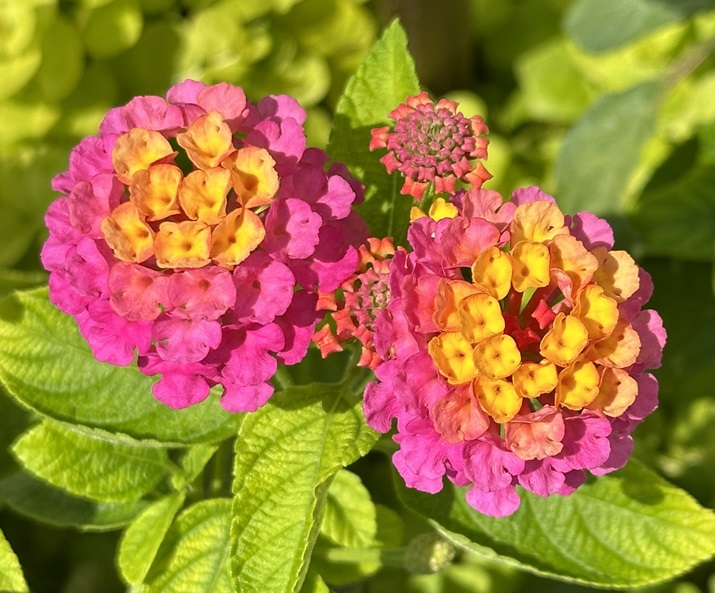
Lantana (Lantana camara) is a heat-loving shrub from the American tropics, grown for its rounded clusters of tiny tubular flowers in yellow, orange, red, pink, purple, cream and white. The flowers often change color as they age, so one cluster shows two or three shades at once, like the pink and yellow-orange heads in the photo. The rough, toothed leaves have a pungent smell when crushed, and some types have small prickles on the stems.
Most garden lantanas are cultivars and hybrids of L. camara, some crossed with trailing lantana (L. montevidensis), a low, spreading species with lilac or white flowers. Where lantana is perennial it grows into a shrub 3 to 6 feet tall. As a summer annual most cultivars reach 1 to 3 feet tall and wide, and trailing types stay under a foot but spread wider.
Hardiness
Lantana is evergreen in zones 10 and 11. In zones 8 and 9 frost kills it to the ground and it regrows from the roots in late spring; a few hardy cultivars such as 'Miss Huff' can survive in zone 7. Everywhere else, grow it as an annual. Plant after your last frost once the soil is warm (check your dates with our zip code lookup); lantana sits and does nothing in cool weather.
Growing lantana
- Light: full sun, ideally 8 hours or more. In shade it flowers poorly and gets powdery mildew.
- Soil: any well-drained soil, including poor, sandy soil. Wet soil causes root rot.
- Water: water new plants regularly. Established plants in the ground are drought tolerant; containers need watering often in summer.
- Feeding: little or none. Too much fertilizer gives leaves instead of flowers.
- Trimming: if flowering slows in midsummer or the plant fills with berries, shear it back by about a third. It reflowers within a few weeks. Berries cut down on new flowers.
- Spring cleanup: in zones 8 and 9, wait until new growth appears in spring, then cut the dead stems back to live wood.
- Pests: lantana lace bugs, which leave leaves gray and stippled, are common in the South. Whiteflies and spider mites also show up, especially in pots.
To keep a container plant over winter, bring it indoors to a sunny window, or let it go dormant in a cool garage and water it only lightly until spring.
Butterflies and hummingbirds
Lantana is one of the best nectar plants for butterflies, and hummingbirds visit it too. It earns a spot in any butterfly garden. Deer and rabbits rarely touch it.
Toxicity and invasiveness
The leaves and the green, unripe berries are poisonous to people, pets and livestock. Keep children away from the berries.
In Florida and Hawaii, Lantana camara is a serious invasive plant. Birds spread the seeds into natural areas, and in Florida it also crosses with the native rockland lantana (Lantana depressa). If you garden there, choose sterile cultivars such as the University of Florida's 'Bloomify Red' and 'Bloomify Rose', or a native lantana.