Growing Green Onions in the Home Garden
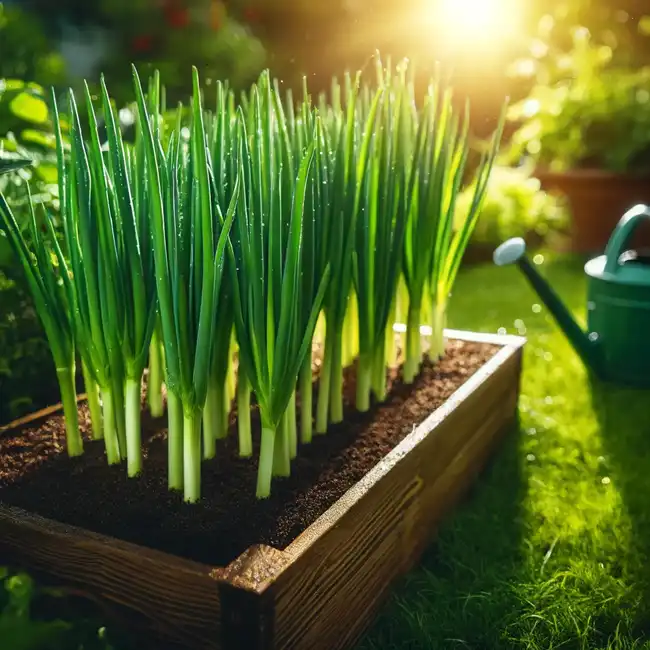
Green onions, also called scallions, are onions harvested young for their mild green leaves and slender white base. They are one of the easiest crops to grow: they take little space, tolerate cold, grow well in containers, and many types regrow after cutting.
They are rich in vitamin K and a source of vitamin C.
Which onions to grow
- Bunching onions (Allium fistulosum, also called Welsh onions) are the true scallion. They never form a bulb, stay straight-sided at the base, and are perennial: a plant divides into a clump, and a few clumps left in the ground will come back the next spring. 'Evergreen Hardy White' is a common, very cold-hardy variety.
- Common onions (Allium cepa) sown thickly and pulled young also make green onions. Left longer, they start to swell at the base and are sometimes sold as spring onions.
Both belong to the onion family, along with chives, leeks and garlic.
Planting
From seed. Green onions tolerate cold, so you can sow outdoors as soon as the soil can be worked in spring, a few weeks before your last frost date, and keep sowing through late summer. Find your dates with the zone and frost date lookup. Sow 1/4 inch deep, about 1/2 to 1 inch apart, in rows or bands 12 inches apart. Seed sprouts slowly in cold soil, faster once it warms. Expect usable scallions about two months after sowing.
From sets. Small onion sets planted 1 to 2 inches apart give green onions in about a month. Pull them before they start to bulb.
From kitchen scraps. Plant the root ends of store-bought scallions, with about an inch of white attached, in soil or a pot. They regrow leaves within a couple of weeks.
Succession. For a steady supply, sow a short row every three to four weeks. See succession planting.
Site and care
- Sun: full sun (6 hours or more) gives the best growth; plants tolerate a little shade.
- Soil: loose, fertile, well-drained soil with plenty of compost and a pH of 6.0 to 7.0.
- Water: the roots are shallow, so keep the soil evenly moist. Mulch helps.
- Weeds: the thin leaves can't compete, so weed often while plants are small.
- Feeding: a light feeding with a balanced or nitrogen-rich fertilizer every three to four weeks keeps leaves growing, especially on plants you cut repeatedly.
- Containers: green onions are among the best vegetables for pots. Any container 6 inches deep works.
Pests and diseases
- Onion maggots tunnel into the base of the plant, which wilts and yellows. Rotate onion-family crops to a new spot each year and cover new sowings with row cover.
- Thrips leave silvery streaks on the leaves, mostly in hot, dry weather. A strong spray of water knocks them back; insecticidal soap or spinosad helps with heavy infestations.
- Downy mildew shows as pale, fuzzy patches in cool, wet weather. Give plants room for air to move and water at the base.
Harvesting
Pull green onions whenever they are big enough to use, usually 8 to 12 inches tall and about pencil-thick. Pulling every other plant thins the row and leaves room for the rest to grow.
For repeated harvests, cut the leaves about an inch above the soil instead of pulling. Bunching onions regrow several times; common onions regrow less. Let a few bunching onion clumps stay in the ground over winter for an early harvest the next spring.
Green onions keep about a week in the refrigerator, wrapped in a damp paper towel inside a bag.